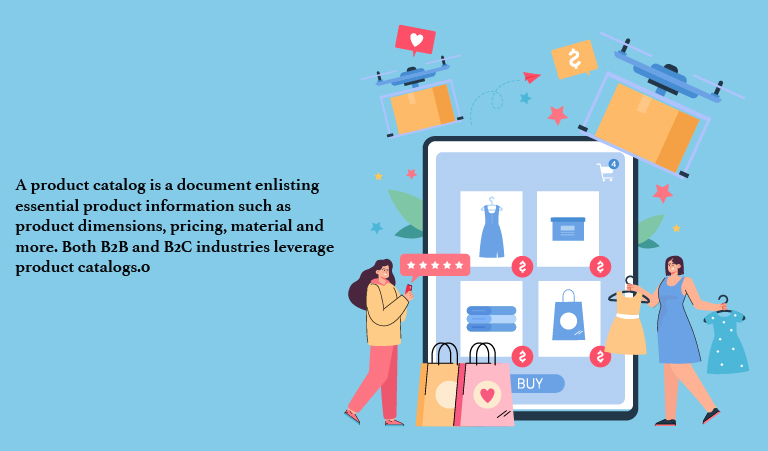
Have you ever wanted to create a product catalog? Your point is well taken. Organizing all your product information in one place is tremendously useful for marketing and sales, thus growing your revenue. Product catalogs are useful not only to buyers, but also to retailers, marketers, and sales representatives since they categorize product information.
Perhaps the best part is that your visually engaging product catalog is only a template away from everything you'll discover today. Find out how CatalogsBuilder offers product catalog management for your website. Here is a detailed guide covering what is a product catalog on a website and why do we need product catalogs:
What is a Product Catalog?
Among the crucial information contained in a product catalog are the dimensions, pricing, and materials of the product. Product catalogs are used both in the B2C and B2B industries. It's not just e-commerce either. Product catalogs are also used by offline shops and service-based businesses. But the question here is what is the purpose of doing this? The answer depends on who the audience is.
The goal would be to convert the buyer as they browse your product catalog. Additionally, a sales representative would use it to help them convert prospects into customers by providing relevant product information. However, there are various shapes and sizes of product catalogs. The benefit of this is that you can design physical catalogs that look like magazines and online product catalog (documents like interactive PDFs) that you can upload onto your web pages. Among other things, Forbo Holding, a manufacturer of floor coverings, offers both PDF catalogs (organized on their website) as well as a digital library organized according to product category.
There is no doubt that online product catalogs are more useful than paperback product catalogs with the rise of online shopping (2.14 billion or 27.6% across the globe shop online). Since you know your audience and their shopping preferences, the choice is yours.
Product Catalogs: Why do you need them?
Essentially, a product catalog should categorize products in a simple manner that readers can understand or use to source information. You need a product catalog for the following reasons:
1. Makes decisions easier
Based on the product details in a product catalog, buyers can choose which products to buy from your company.
2. Improves user experience and shortens the buyer's journey
Having a professionally designed catalog shows off your professionalism and ability to provide value to your customers.
Due to the fact that most shoppers buy online - or, at least, start their search online - a product catalog provides all the information the buyer needs to make an informed decision. Additionally, interactive catalogs make it possible for them to learn more about you, read case studies and read customer reviews.
3. Plan and implement new products
Product catalogs also assist product marketers in defining and mapping new product offerings by providing an overview of all commercial products.
4. Sales process is improved
With a product catalog, sales reps can find all the information they need in one place. As a result, they can have more meaningful sales conversations, increasing conversion rates and engaging prospects better.
5. Marketers will find these materials useful
In order to share enticing product details in content they create and advertisements they run, marketers can easily reference product details such as colors available and discounts.
6. Streamlines employee onboarding and training
It is easier for new hires, such as salespeople, to find product details in a solid product catalog.
By doing this, not only does training employees become easier, but also getting product information from various departments becomes easier.
7. Guides external partners and field marketers
As a final step, your catalog can be used by external partners for customer sharing. A catalog is also used by field marketers to give accurate product and pricing information to customers when giving them product demos.
Product Catalogs: What's in them?
Information about each of your products should be included in your product catalog since it provides a detailed overview of your product pool:
- Images
- Detailed description
- Its features
- Size and other dimensions
- Materials such as copper for instance
- Directions for care
- Precautions
- ISO 9001 certifications
- Review credentials (e.g., customer ratings)
- Any available discounts
- Calls to action like "buy now" or "book a demo"
- Documents such as data sheets, installation guide, etc.
Consider Nestle's catalog as an example of a simple but effective product catalog. I think it's worth mentioning that the company has kept the design of its product catalog clutter-free. Furthermore, it simplifies organizations by allowing them to create catalogs for various products. Nestle sells multiple products, so this is useful for them. Second, the company has incorporated its products into its on-brand catalog, so they feel like a natural extension of the business family.
Conclusion
It's time to wrap up our guide to high-converting product catalogs. Focus on creating a simple, easy-to-use, and breathable design. Don't forget to use high-quality images for your product images. Keep your descriptions short and sweet. Be sure to gather all product data and create a mockup to save you time by sharing only the essential details in your text. You can design a product catalog if you don't already have one. As a bonus, we've also put together an article about how you can manage your product catalogs so that you can start growing your business using them. For any further information you can contact CatalogsBuilder today if you already have a website and need help managing product catalogs for it.






0 Comments